
English/Ελληνικά
24-HOUR WILDLIFE RESCUE PHONE NUMBER: +30 697 679 7070
The dark side of fireworks and flares
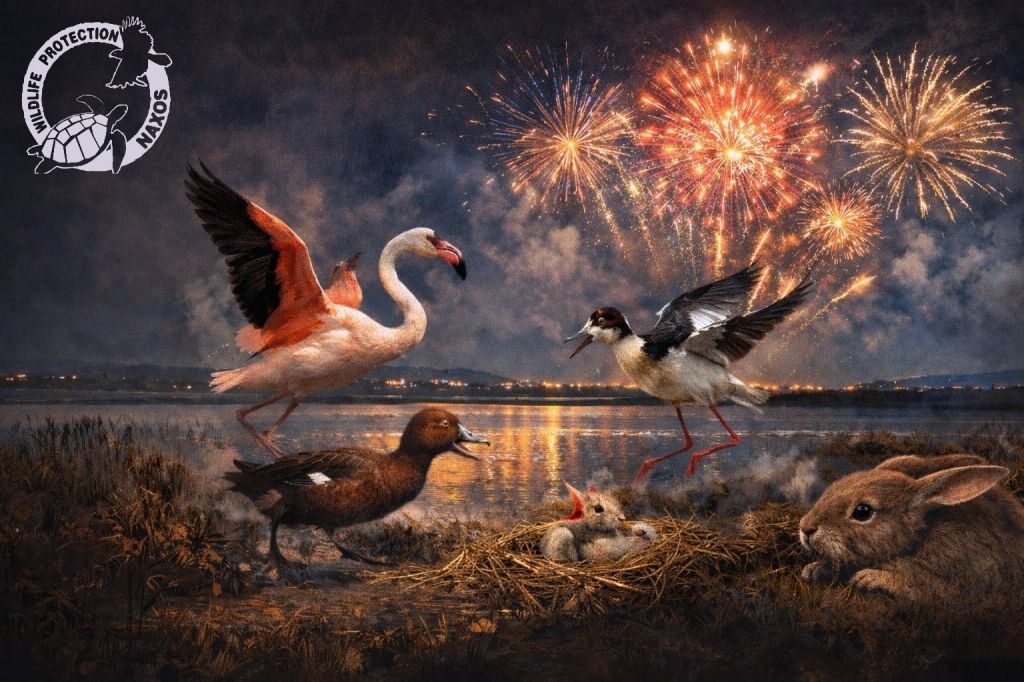
Fireworks and flares are part of celebrations in many countries, but their brilliance hides a darker side. For animals, these explosions are no different from scenes of war: loud noises, intense lights, smoke and airborne particles create a hostile environment, causing extreme stress and panic.
Small creatures such as Sardinian Warblers and Chiffchaffs that roost in our gardens, as well as larger species like Buzzards, wild ducks and Flamingos, are deeply affected by these explosions. Research in Austria has shown that the heart rates of wild birds increase by up to 96% during New Year’s fireworks, while their body temperature rises by 3%—clear indicators of extreme stress.
Even more concerning is the fact that birds need up to five hours after fireworks to return to normal levels. Such a sudden spike in stress can lead to cardiac arrest and death, while the sense of terror drives them to fly away from the noise, covering distances they would normally only travel during migration.
In the days following fireworks, bird behavior changes dramatically: they move less but increase their food intake in an attempt to compensate for lost energy, making them more vulnerable to predators and environmental pressures.
During winter, when food is scarce, this energy loss caused by fireworks can lead to exhaustion and an inability to continue their journey.
In spring and summer, during migration and nesting periods, sudden escape flights and panic caused by deafening noise can disorient birds, causing them to lose contact with their nests and chicks who cannot survive without their parents.
Nighttime fireworks, such as those during Easter, pose even greater risks: many birds collide with buildings and glass surfaces, fall into the sea, or die from cardiac arrest. The larger the bird, the farther and higher it will fly to escape the terror. Geese and wild ducks can remain airborne for hours, trying to get away from the source of the noise.
What is most alarming is that wild animals cannot get used to these “festive” explosions. In regions like Greece—especially in rural areas—where access to and use of fireworks or even firearms is easier within a “celebratory” context, the danger to wildlife is even greater.
Beyond national legislation on fireworks, there is also the European Birds Directive, according to which member states are obliged to take measures to prevent the deliberate disturbance of wild birds in protected areas.
The wild birds currently on our islands have already traveled hundreds of kilometers over vast seas, busy cities and coastlines, over shrinking or reclaimed wetlands, searching for a safe place to rest, feed and regain strength before continuing their long journey north.
Yet everywhere, people celebrate with noise, without thinking of our most vulnerable co-inhabitants – infants, pets, and even less so the wildlife that struggles every day to survive against countless threats.
Bib
Bibliography
Follow us on social media!


 Naxos Wildlife Protection